
The Carter School Alumni Chapter is a living extension of a shared journey--bringing graduates together to connect, inspire, and serve. Rooted in pride and guided by purpose, the chapter fosters engagement with students, lifelong bonds, and meaningful impact within our communities and beyond.
By engaging alumni in service, the chapter strengthens its collective voice and ensures the legacy continues to inspire progress and positive change through programming and outreach.
Carter School Alumni Chapter Board

Julie Rouge, PhD '19, President
Juliette Rouge, PhD '19, is the Dean of the School of Security and Global Studies at the American Public University System (APUS). She oversees a student community of more than 23,000 students across eight academic departments and represents APUS at the “College in 3 Exchange", focused on innovations in higher education.
An active conflict resolution practitioner, she works internationally on peacebuilding in divided communities and developing local leadership capacity with communities in Ukraine, Serbia, Myanmar, and Central Asia. Locally, she works with communities to collaboratively address contentious local issues.
Previously, Rouge worked at George Mason University for 17 years, where she held the positions of Associate Dean and Associate Professor at the Carter School for Peace and Conflict Resolution.
Dr. Rouge holds a Ph.D. and Master of Science in Conflict Analysis and Resolution and a Master of Business Administration from George Mason University, as well as a Bachelor of Arts in Political Science and Psychology from George Washington University. Her research includes work on the relationship of media to conflict, specifically focused on media coverage of terrorism and the role of women in political violence.

Ramesh Sepehrrad, PhD '08, Vice President
Dr. Ramesh Sepehrrad is a Visiting Fellow at the Jimmy and Rosalynn Carter School for Peace and Conflict Resolution, where her work sits at the intersection of conflict analysis, governance, and the security challenges of the digital era. A scholar-practitioner and technology executive with more than two decades of leadership across public, private, and academic settings, she advises organizations on enterprise risk, cyber resilience, governance, and responsible innovation.
Her research and public writing examine how sociotechnical systems, platforms, information ecosystems, and institutional incentives, shape social conflict, polarization, and pathways to durable peace. She is the author of academic book: Cyber, Social Conflicts and Humanity and has presented at major venues across academic institutions in US and Europe. She also serves as a founding leader of the Center for Security Innovation at University of Connecticut and Vice President of Data & AI Risk at Navy Federal Credit Union.

Mystelle Ruble, MS '13, Secretary
Mystelle Ruble, MS '13, received her master's in conflict analysis and resolution from the Jimmy and Rosalynn Carter School for Peace and Conflict Resolution. She brings extensive experience in international development across Asia, the Middle East, West Africa, and Central America, working in conflict, post-conflict, and transition contexts. Her work focuses on conflict resolution and conflict-sensitive development programming. Most recently a self-employed senior strategy advisor, she has held leadership and project and portfolio management roles with Creative Associates and Chemonics International.
Mystelle is excited to join the alumni chapter board to connect alumni and students through programming and events that serve the entire Carter School community. She aims to engage alumni from diverse cohorts and sectors to facilitate networking, shared learning, and knowledge exchange within the evolving peacebuilding sector.

Janna Tosson, BA '27, Student Representative
Janna Tosson is an undergraduate student pursuing a dual degree in Conflict Analysis and Resolution, with a concentration in Political and Social Action, and Government and International Politics. She also has a minor in Dance Appreciation.
Janna has served as the Community Chair of the Carter School Ambassadors since Fall 2024. She is currently a fellow at the Office of Community Engagement and Civic Learning and an undergraduate research assistant. Additionally, she serves as the Executive Director of NLG @ George Mason, a student organization working to make higher education accessible for refugee students, and the Human Security Division Chief for the Sycamore Institute, the first foreign policy and national security-focused undergraduate-run think tank. In these roles, she has gained experience in bridging theory with practice. She's passionate about ethical community engagement and the utilization of international law to support grassroots peacebuilding initiatives globally.
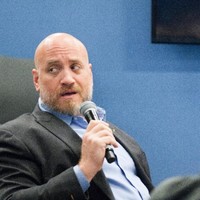
David Alpher, PhD '11, Director at Large
David Alpher, PhD '11 is an expert in peacebuilding, conflict prevention, and foreign assistance with over two decades of experience spanning the Middle East, Horn of Africa, and Sahel. Currently serving as the Director of Public Policy Federal Outreach for the American Academy of Actuaries, he has built a distinguished career bridging the worlds of research, policy, and field operations — from managing multi-million-dollar humanitarian programs in Iraq to leading policy advocacy for international peacebuildingorganizations. Among other positions, he previously served as the Conflict and Violence Prevention Integrator for USAID's Center for Conflict and Violence Prevention, a Humanitarian Assistance Advisor to the Military for the Bureau of Humanitarian Assistance, and as the US Head of Office for Saferworld, a British peacebuilding organization. A prolific writer and public commentator, Dr. Alpher also serves as an adjunct faculty member at George Mason University, American University and Syracuse University, where he teaches on international development in fragile environments, and global conflict dynamics. His expertise spans human rights, governance, countering violent extremism, civil-military coordination, and humanitarian assistance, and he has advised and briefed audiences ranging from Congress and the Department of State to Coalition military forces.

April Umminger, MS, Director-at-Large
April Umminger is a senior crisis and communications expert, who has worked for media, nonprofit, corporate, association, and agency clients. She spent 14 years as a journalist at the Washington Post and USA Today, where she covered the Columbine High School shooting and the September 11 terrorist attacks. Umminger was part of the team at the Washington Post awarded the Pulitzer Prize for breaking news in 2008 for its coverage of the shooting at Virginia Tech.
After leaving print media, Umminger used her background to pursue a career in crisis communications and public relations. She led the response to the largest technological breakdown in the history of the company at BlueCross BlueShield of North Carolina, drove the media response to Superstorm Sandy for shareholder utility companies at Edison Electric Institute, and oversaw the communication for returning to the office and office consolidations at Red Hat.
Umminger holds a BA in English Literature from the University of North Carolina at Chapel Hill, and an MS in Conflict Analysis and Resolution from George Mason University. She was part of the study abroad course that worked with Syrian refugees in 2015, and wrote about the experience for USA Today. She is currently Associate Director of Global Communication at IQVIA, a Fortune 500 company.

Fernando Palacio, PhD, Director at Large
Peace and conflict scholar and educator specializing in human rights, mass atrocities, and higher education’s role in social transformation. As a MEXT Japan fellow, Fernando earned his PhD in Peace and Conflict Studies from Tokyo University of Foreign Studies, where he obtained a Master’s in International Cooperation; later, as a Scheidt fellow, he obtained a new Master’s degree in Conflict Analysis and Resolution with a Graduate Certificate in Mass Atrocity and Genocide Prevention from George Mason University’s Carter School. Since then, he has focused on systemic erasure, and LGBTQ+ rights, examining how invisibility and denial of personhood works in structures of power in combination with universities role a agents of peace His academic and professional work has focused extensively on human rights protection in Burma and Southeast Asia, including research and field-based engagement on child soldiers, refugee protection, and human rights documentation along the Thai-Burma border and the region at large. He has held teaching and research appointments at institutions including Kyoto University, the University of Tsukuba, Doshisha University, and Tokyo University of Foreign Studies. His work integrates peacebuilding, civic engagement, and University Social Responsibility (USR), emphasizing how universities can advance justice, inclusion, and sustainable development. He has advised universities and regional networks across Asia on internationalization, student mobility, and socially engaged research, and has published widely on higher education and global responsibility.

Oakley Thomas Hill, PhD Candidate, Director at Large
Oakley Thomas Hill is a Ph.D Candidate and Graduate Lecturer at George Mason University’s Jimmy and Rosalynn Carter School for Peace and Conflict Resolution. His research explores the intersections of social conflict and the construction of meaning, and his current research interests include religious deconversion, political ideologies, and U.S. social conflict. His recent publications include “The Epistemic Eclipse: Narrative, Ideology, and the Political Situation” and “Clan Elders and Traditional Reconciliation in Somalia.” He has done contract work for the United States Institute of Peace, The Mary Hoch Center for Reconciliation, and the Al Amana Centre, among others.